Case Study · Discovery & Strategy

Creating clarity through exploration

A four-month discovery and strategy engagement for Activate Games — evaluating whether a native mobile app was the right investment, and uncovering where the real opportunities for growth were.
Activate Games app — hero mockup
ClientActivate Games
RoleLead UX Designer & Researcher
Team2 Designers
ScopeDiscovery & Strategy Engagement
Duration4 Months

Was a mobile app worth the investment?

Activate Games delivers a highly engaging in-person experience, but as the company expanded, leadership needed to determine whether investing in a native mobile app would create enough value to justify the cost and complexity.

As Lead UX Designer and Researcher, I led a discovery engagement to evaluate user needs, operational constraints, competitive trends, and technical feasibility — to determine whether a mobile app was the right strategic investment.

  • Increase repeat visits
  • Improve weekday attendance
  • Identify operational and digital opportunities that could drive business growth
  • Increase conversion from first-time visitors to repeat customers
  • Improve underperforming weekday bookings
  • Uncover operational and product opportunities beyond the mobile app question
  • A fragmented technology ecosystem with limited integration capabilities
  • Recommendations had to balance user value with operational feasibility
  • The solution needed to scale over the long term
Phase 01

Discovery

A three-phase engagement

Phase 1 · Discover

Gather the full picture

On-site observation, surveys, stakeholder interviews, competitive analysis, and a technology audit.

Phase 2 · Synthesize

Make sense of it

Journey maps, personas, affinity mapping, empathy maps, and service blueprints.

Phase 3 · Recommend

Turn insight into strategy

Product strategy, feature prioritization, and technology recommendations.

Research methods

A mixed-method approach let us evaluate the full customer journey while understanding both operational realities and market expectations.

User interviews

We ran in-depth interviews with first-time and returning guests, alongside frontline staff, to understand the full arc of a visit — from planning and arrival through play and follow-up. Interviews surfaced the emotional highs and the friction points that numbers alone couldn't explain.

  • What motivated people to visit — and to come back
  • Moments of confusion during games and check-in
  • Barriers that kept guests from visiting on weekdays
  • What made a visit feel worth repeating

Summary

Wait times

  • All guests expressed frustration with wait times at their respective locations.
  • Technical issues take games offline, making waits even longer.

Sound

  • 3 of 4 guests were frustrated with sound levels — it often made instructions hard to hear, making gameplay more difficult.

Badges & challenges

  • All guests found it difficult to work toward badges, with little visibility into what each one takes to earn.

Game-play requirements

  • Requirements either stopped guests from playing (too few people) or hurt the experience (too many for one room, physical demands).

Cost

  • Guests felt the value is still good, but wished for membership options or discount days so they could visit more often.

Summary

Special events & badges

  • All guests were interested in special events — from exercise classes in the mega grid to themed days (holidays, retro nights, local game-store collabs) and location-based events.

Small-scale competition

  • 3 of 4 guests were excited by smaller-scale competitions — even "teams" of friends and family who compete by tracking and comparing scores.

Queues

  • All guests liked digitally queuing rooms or preplanning their visit. Knowing the wait up front made it easier and set reasonable expectations.

User surveys

A broader survey validated the interview themes at scale and quantified how often each friction point actually occurred. It let us separate loud-but-rare complaints from the issues affecting most guests — turning anecdotes into priorities we could act on with confidence.

  • Which features guests most wanted from an app
  • What would motivate more frequent visits
  • How wait times affected overall satisfaction
  • Comfort with digital tools like check-in and reservations

Top value-adds people want in an app

% of respondents · n = 124
Discounts / promotions0%
Extend time without leaving the game area0%
Track stats — rewards, leaderboards0%
Instant check-in / waiver signing0%
Time reminders / warnings0%
Game mode instructions / tutorials0%

What would make people return more often

% of respondents · n = 158
Discounts / promotions0%
More / different game modes0%
Knowing wait time is shorter0%
Special events0%
"Adult Swim" (18+)0%
Designated quiet play hours0%
Users wanted to return — they simply needed more information, control, and reasons to stay engaged between visits.
— Consistent theme across every research method

Competitors were already going digital

Activate's closest competitors were already extending their experiences through mobile apps — suggesting an app wouldn't just meet user expectations, but create a foundation for long-term engagement.

  • Reservations
  • Rewards programs
  • Progress tracking
  • Push notifications
  • Event management
  • Social competition

Research revealed three primary friction areas

01

Game familiarity & awareness

Many guests struggled to understand the available games, rules, and features. Without effective onboarding, instructions, or accessibility support, confusion often became frustration.

02

Planning & time management

Wait times were the strongest predictor of customer satisfaction. Guests wanted:

  • Better visibility into wait times
  • Faster check-in experiences
  • More control over how they spent their time
03

Social experiences & community

Repeat visits were driven less by discounts and more by novelty, competition, and shared experiences. Users wanted to:

  • Compete with friends
  • Track progress
  • Participate in events
  • Engage with the community between visits

Mapping opportunity to Bartle's player types

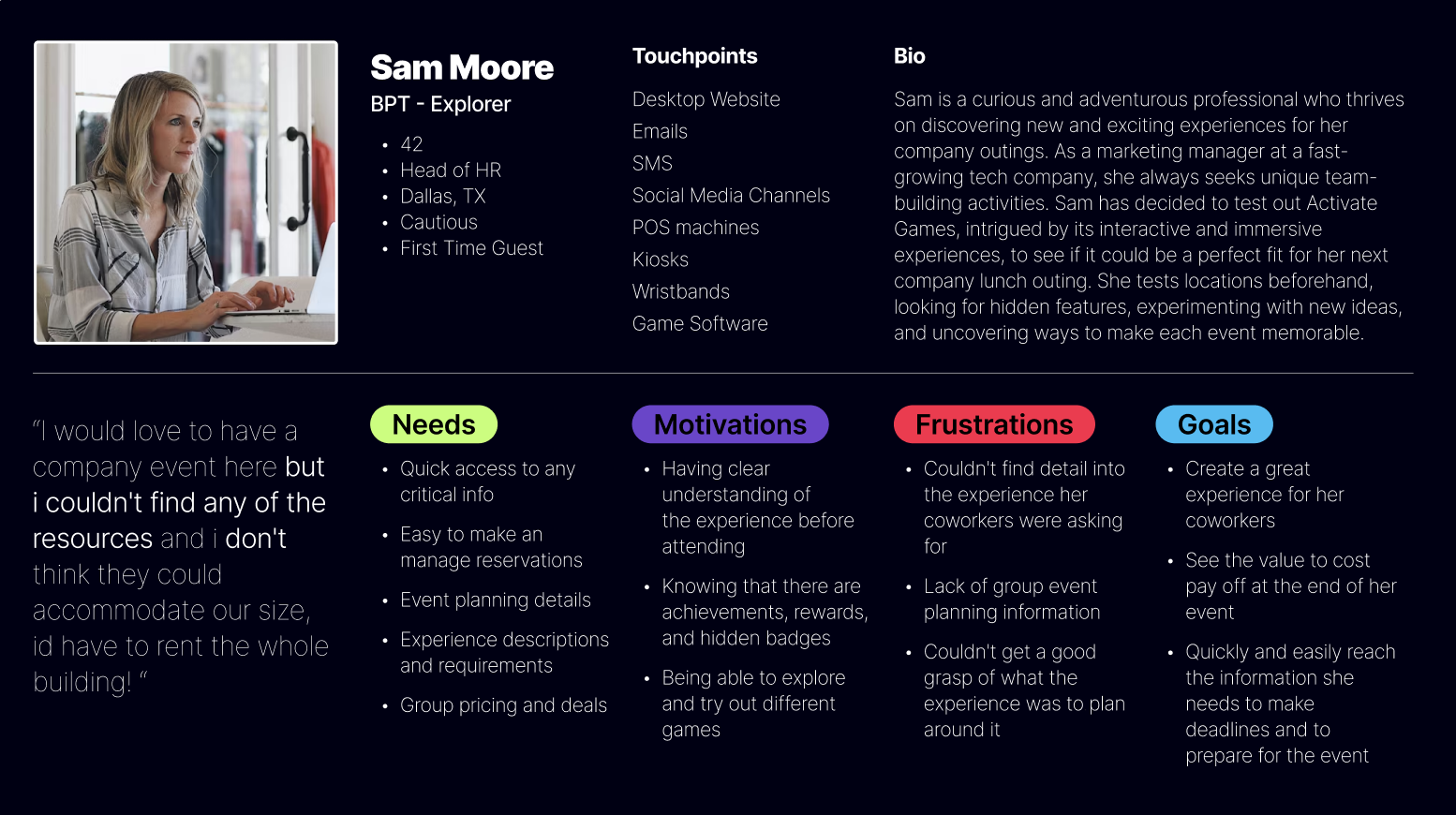
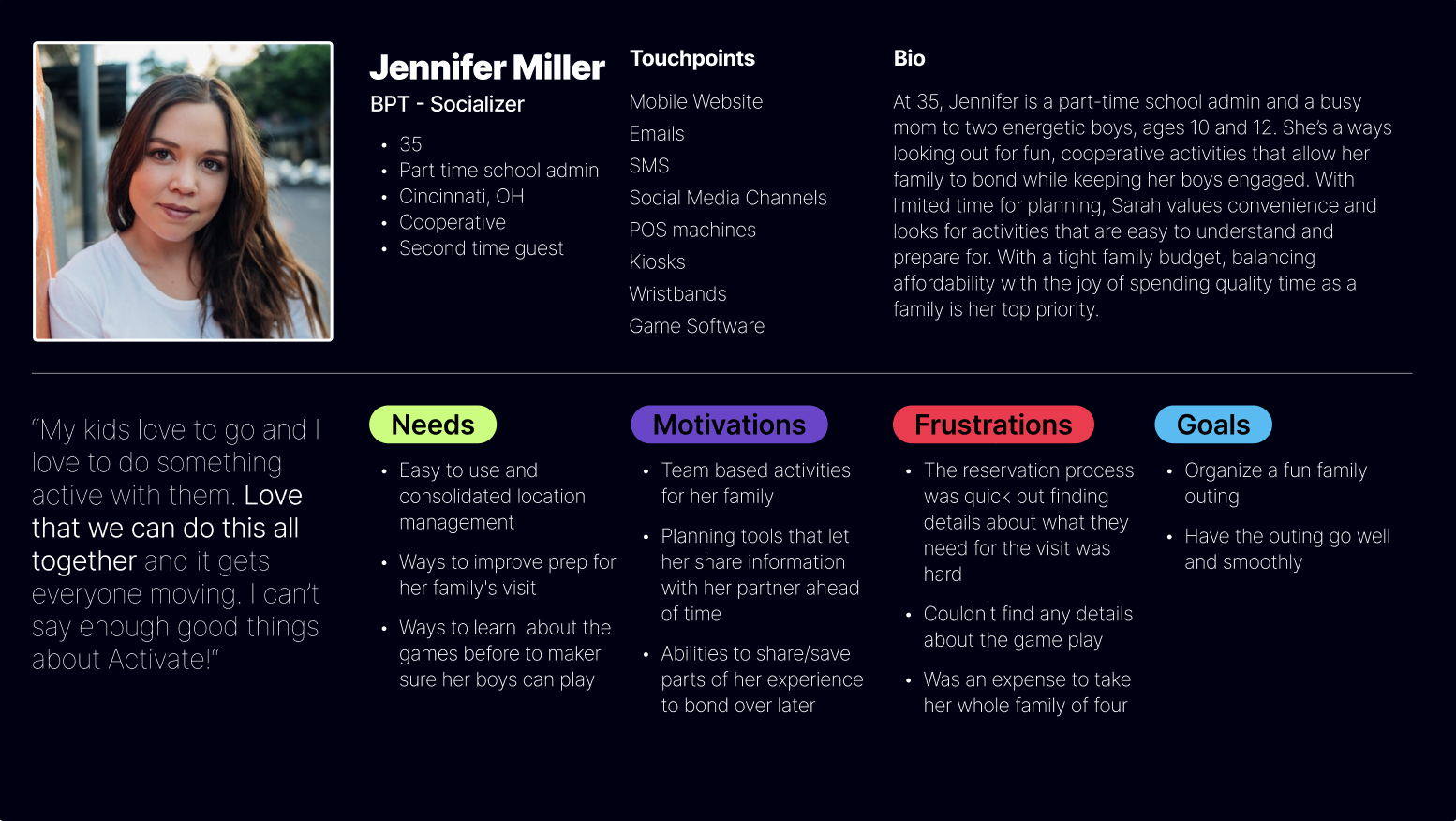
Bartle's player types gave us a lens for understanding what motivates different guests — and which features each group would actually care about. By mapping opportunities to achievers, socializers, competitors, and explorers, we could see where a feature would land and for whom. These motivations carried directly into our personas, grounding each one in a distinct set of needs rather than demographics alone.
Player typeOpportunity
AchieversProgress tracking, badges, leaderboards
SocializersGroup scheduling, event coordination
CompetitorsStat comparison and rankings
ExplorersChallenges, unlockables, hidden achievements
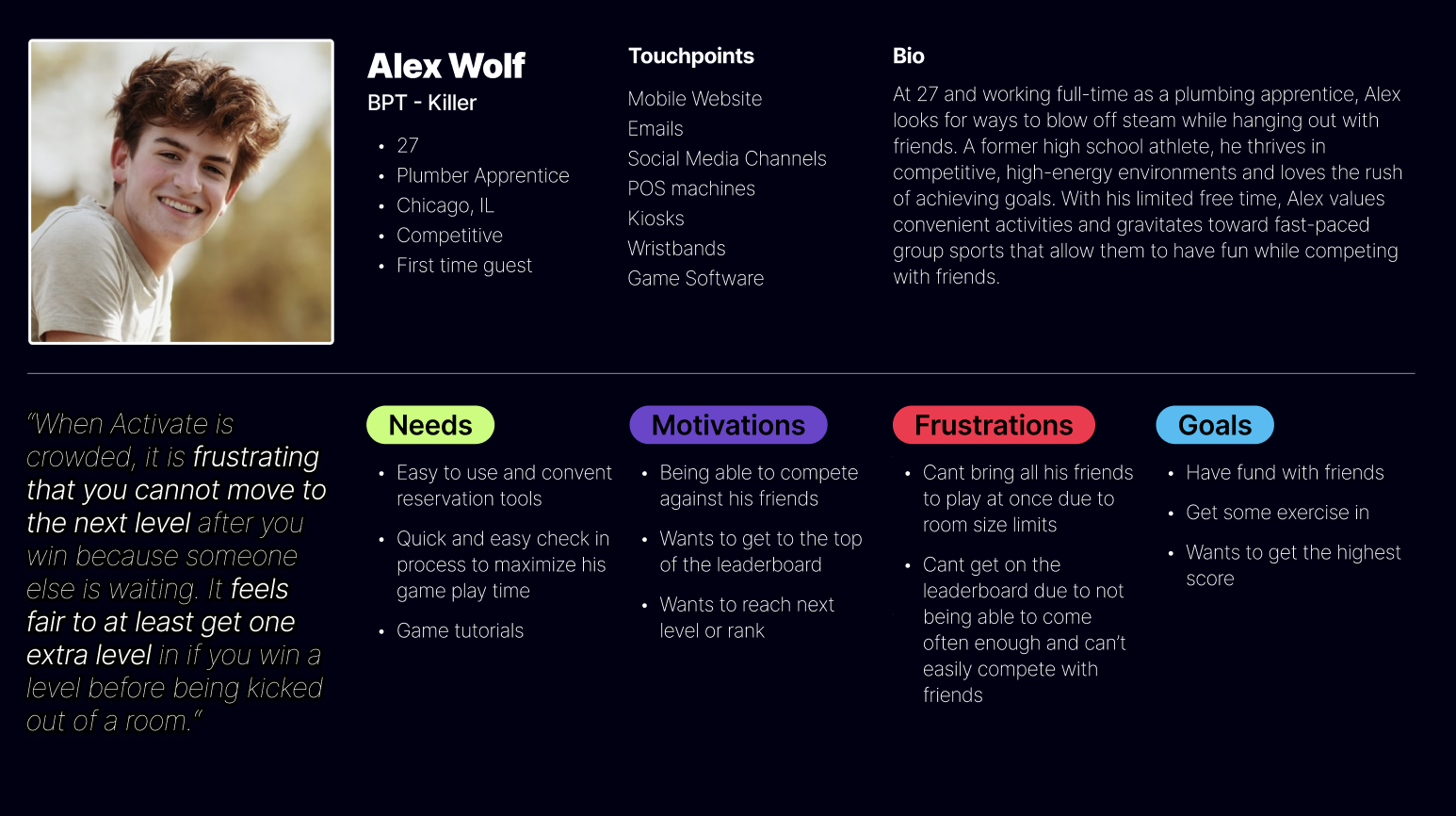
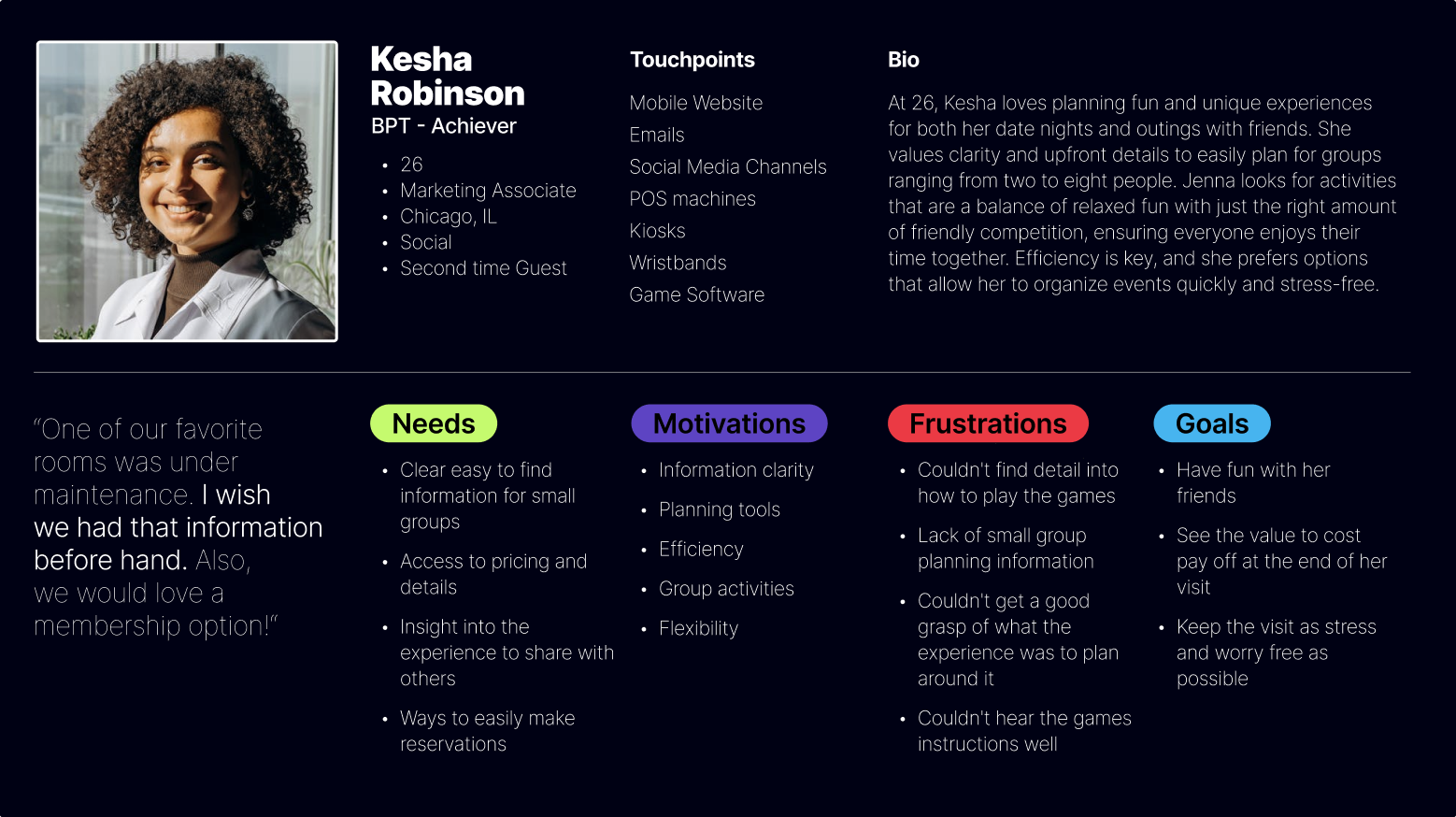
Persona — Kesha Robinson, party planner
The Achiever
Driven by progress, badges & leaderboards
Persona 2
The Socializer
Comes for shared experiences & events
Persona 3
The Competitor
Motivated by rankings & head-to-head play
Persona 4
The Explorer
Seeks novelty, challenges & hidden finds
Phase 02

Strategic Recommendation

Findings translated into three strategic initiatives

Awareness
  • Game tutorials
  • Accessibility tools
  • Sound & instruction support
  • Game information
  • Onboarding
Planning
  • Wait-time visibility & estimates
  • Digital queues
  • Reservations & digital waivers
  • Accelerated check-in
  • Session management
  • Push notifications
  • Personal statistics
Community
  • Competitions
  • Leaderboards
  • Badge & achievement systems
  • Event calendar
  • Social sharing
  • Community engagement

Each recommendation mapped directly back to both user needs and business goals.

Sharing findings early and often

Findings were shared after each research phase, allowing stakeholders to validate insights, influence priorities, and stay aligned throughout the process.

Continuous communication let us adapt the research approach as new findings emerged — while preserving confidence in the final recommendation.

Outcome

Impact

Yes — building a mobile app was a strategically valuable investment.

Beyond the recommendation

The project gave leadership both a product strategy and a broader business strategy for future growth.

What I learned from this project

Adaptability strengthens research

Strong discovery work requires a structured plan — but great discovery work adapts when new insights emerge. Being willing to pivot methods while maintaining rigor produced a stronger outcome than following a fixed process.

Operational systems shape product strategy

Technology limitations and operational workflows don't just influence design decisions — they often define them. Connecting technical constraints, business realities, and user needs helped me become a stronger strategic partner.

Like what you see? Let's make something together.